When Working Together Becomes Hard
Oct 18, 2026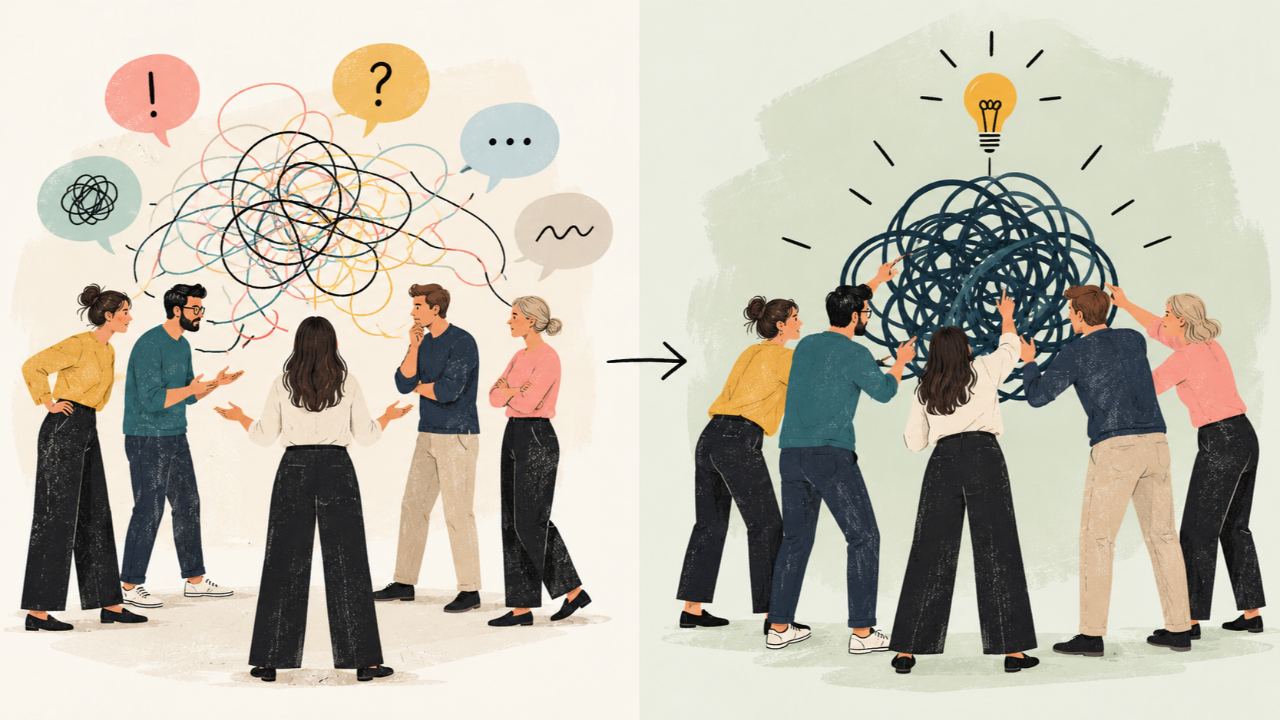
The hidden cost of team tension, and why shifting from people to problems matters.
Sometimes the signs that something isn't working in a team are difficult to pinpoint. People are still doing their jobs. Meetings are happening. Decisions are being made. But somehow, everything seems to require more effort than it should.
Conversations are carefully planned, difficult subjects are avoided, and people spend time figuring out how to approach each other rather than addressing the work itself. There's tension, even when nobody is openly disagreeing. All that energy spent navigating relationships is energy that isn't going into solving problems together.
So what's actually happening?
When working together becomes unnecessarily difficult
Tension doesn't necessarily mean people are unwilling or unable to collaborate. Often, everyone is simply trying to do a good job. But perhaps expectations haven't been clearly understood, responsibilities overlap, priorities have changed, or people have different interpretations of what they're working towards. Organisational change can make these situations even more complicated.
When misunderstandings aren't addressed, people begin making assumptions about one another. Someone becomes frustrated, another person withdraws, and others start tiptoeing around the situation because they're worried about making things worse. Before long, people may be spending more energy managing the tension than addressing whatever created it.
And that has a cost, not just in time and productivity, but in people's willingness to ask questions, offer help, challenge ideas, or raise concerns.
The connection to psychological safety
Amy Edmondson's foundational research describes psychological safety as a shared belief that a team is safe for interpersonal risk-taking. Her 1999 study of 51 work teams found that psychological safety was associated with learning behaviours such as seeking feedback, discussing mistakes, and sharing information.
Psychological safety isn't simply about being comfortable or getting along. It's about being able to ask for help, admit uncertainty, challenge an idea, or acknowledge a mistake without worrying about negative interpersonal consequences. When someone begins calculating how another person might react before asking a question or raising a concern, the perceived effort and risk of contributing may start to outweigh the benefit.
Sometimes silence becomes the easier option. Research on employee voice and silence, including Elizabeth Morrison's 2014 review, helps explain why employees sometimes withhold concerns, questions, or suggestions that could benefit their organisations. Silence doesn't necessarily mean people have nothing to say. Sometimes speaking up simply feels too costly.
Start with curiosity, not judgement
When leaders recognise tension in their teams, there's often a temptation to bring everyone together and ask what's going on. But that can be risky. If people already feel uncomfortable, asking them to discuss sensitive issues in front of colleagues might make matters worse.
Before bringing people together, we need to understand what's actually happening, and that starts with curiosity. What are people experiencing? Where are expectations unclear? What might be making collaboration unnecessarily difficult? And importantly, what role might leadership behaviour or decisions have played in creating the situation?
Sometimes individual conversations are the most useful starting point. They allow people to share their perspectives without immediately having to defend them. By listening to different experiences, leaders can begin identifying common patterns rather than focusing on individual frustrations. The intention isn't to find someone to blame, but to understand what's creating the difficulty.
Shift the focus from people to problems
This is where I believe one of the most useful changes can happen. Instead of asking why someone is being difficult, we might ask what's happening in the way we work together that's creating these difficulties.
We can then begin reframing the challenges into questions that invite people to find solutions together. How might we create clearer expectations around responsibilities and decisions? How might we make it easier to raise concerns before they become problems? How might we improve the way we ask for and offer help?
These questions change the nature of the conversation. Rather than asking people to defend their behaviour or explain previous disagreements, we're inviting them to work together on a shared challenge. The team begins to see the problem as something they need to solve together, rather than something they need to solve about each other.
This doesn't mean ignoring difficult experiences or pretending that relationships haven't been affected. Sometimes those experiences need to be acknowledged and addressed directly. But reframing the underlying challenges can create an opportunity for more constructive conversations. Instead of being positioned against each other, people can begin working together against the problem.
Creating the conditions for participation
There's an important distinction between asking people to participate and creating the conditions in which they feel able to contribute.
Research by Ingrid Nembhard and Amy Edmondson (2006), involving 23 neonatal intensive care units, examined how leaders invite and appreciate contributions from others. The researchers found that this type of inclusive leadership behaviour was associated with greater psychological safety and engagement in improvement efforts. Although conducted in healthcare, the findings offer a useful perspective for leaders elsewhere.
How we invite participation, respond to contributions, and handle disagreement all matter. Simply telling people that their opinions are welcome isn't necessarily enough. They need to experience that their contributions are taken seriously, and that experience develops through repeated interactions, not just a single meeting.
A gathering can create a turning point
Bringing a team together can be incredibly valuable, but the gathering itself isn't the solution. The value comes from creating an environment where people can develop shared understanding, explore challenges, and agree on how they want to move forward.
That requires preparation. Before bringing people together, we need to understand different perspectives, identify underlying challenges, and be clear about what we're hoping to achieve. Sometimes that means individual conversations first. Sometimes it means acknowledging difficult realities or clarifying what's already been decided and what remains open for discussion. And sometimes it means recognising that the team isn't ready for a collective conversation just yet.
When the conditions are right, a well-designed gathering can help people move from individual frustrations towards shared problem-solving. But we shouldn't expect everything to change overnight.
What happens afterwards matters just as much
One productive conversation or team retreat won't automatically resolve months or years of tension. Changing established patterns takes time, and leadership responsibility doesn't end when the gathering does.
The agreements and understanding developed together need to remain visible afterwards. Leaders can refer back to conversations, revisit challenges, and remind people of what they agreed to do differently. When old patterns return, they can acknowledge them without immediately assigning blame. Hang on, wasn't this something we agreed we'd approach differently?
That shared experience becomes a reference point the team can return to as they continue learning and adjusting. Over time, progress might become visible in small but meaningful ways. People ask for help more readily, offer support without being asked, and conversations flow more naturally. Disagreements become opportunities to understand rather than reasons to become defensive. Perhaps people begin reaching out to one another independently, rather than relying on a leader to manage every difficult interaction.
And perhaps the team starts spending less energy navigating tension and more energy making progress together.
Before you bring your team together
If you've noticed tension in your team, perhaps the first question isn't how to get everyone talking. Perhaps it's whether you've created the conditions for an honest conversation.
Before planning your next team gathering, consider what you're noticing in how people communicate and collaborate, whose perspectives you might be missing, and whether you've understood the underlying challenges rather than focusing on individual behaviours. Think also about what needs to happen afterwards, and how you'll keep the agreements and commitments alive.
Psychological safety isn't something we create by putting it on the agenda. It's something we develop through our behaviour, our relationships, and the way we respond to one another over time.
And sometimes, the most useful thing a leader can do is stop trying to fix the people and start understanding what's making it so difficult for them to work together.
Because when we shift the focus from people to problems, we give people the opportunity to become a team again.
Planning a team gathering?
Bringing people together is an opportunity to create shared understanding, strengthen relationships, and make meaningful progress. But a successful gathering starts long before everyone arrives.
I've created a free Gathering Brief to help leaders clarify why they're bringing people together, what they want to achieve, and how to prepare for meaningful participation.
If you're facing a more complex team challenge and would like support understanding what's happening and designing a productive way forward, I'd be happy to have a conversation.
Research and further reading
Edmondson, A. (1999). Psychological Safety and Learning Behavior in Work Teams. Administrative Science Quarterly, 44(2), 350–383.
https://doi.org/10.2307/2666999
Nembhard, I. M., & Edmondson, A. C. (2006). Making it safe: The effects of leader inclusiveness and professional status on psychological safety and improvement efforts in health care teams. Journal of Organizational Behavior, 27(7), 941–966.
https://doi.org/10.1002/job.413
Morrison, E. W. (2014). Employee Voice and Silence. Annual Review of Organizational Psychology and Organizational Behavior, 1, 173–197.
https://doi.org/10.1146/annurev-orgpsych-031413-091328
Stay connected with news and updates!
Join our mailing list to receive the latest news and updates from our team.
Don't worry, your information will not be shared.
We hate SPAM. We will never sell your information, for any reason.